


OMIM ID:
Fundus Albipunctatus
Alternate Names
Defective Genes
Clinical Characteristics
Ocular Features
This disorder is often considered to belong to the category of retinal disease known as flecked retina syndrome. Further, the nomenclature is not standardized and varying names have been attached to the more or less characteristic fundus picture consisting of uniformly distributed small yellow-white dots in the retina. These tend to be concentrated in the midperiphery. The macula usually is not involved in young people although ERG evidence suggests some worsening of cone dysfunction with age and central acuity may be decreased in midlife. Frank macular degeneration has been seen clinically . Delayed dark adaptation can be demonstrated with delays in recovery of rod and cone function. Patients complain of night blindness beginning in childhood with little evidence of progression.
The disease known as retinitis punctata albescens (136880) may or may not be a unique disorder. It is sometimes grouped with fundus albipunctatus while others consider it to be a separate entity. Evidence for its uniqueness is based on the progressive nature of field loss and the presence of pigmentary changes and retinal vascular attenuation which are not found in fundus albipunctatus. Further, the scotopic ERG waveforms usually do not regenerate. More discriminating studies, especially genotyping, will likely provide additional information. It would also be useful to have additional follow-up information on families.
Systemic Features
No systemic disease is associated.
Genetics
Inheritance
Fundus albipunctatus is a genetically heterogeneous disorder. Mutations in two genes, PRPH2 (6p21.1) and RDH5 (12q13.2) have been found among families. The inheritance pattern for families with mutations in PRPH2 is consistent with autosomal dominant inheritance while mutations in RDH5 result in an autosomal recessive pattern. Mutations in RLBP1 have also been found in some families.
Gene studies so far have not been helpful in discriminating between fundus albipunctatus and retinitis punctata albescens (136880). For example, RLBP1 mutations have been identified among members of the same kindred having the clinical diagnosis of retinitis punctata albescens (136880) among older individuals while younger patients had features of fundus albipunctatus. Further, the latter disorder has also been described among families with mutations in PRPH2 and RHO hinting at further genetic heterogeneity.
A similar clinical picture may be seen in Bietti crystalline corneoretinopathy (210370), Bardet-Biedl syndrome (209900), and hyperoxaluria (259900). More information on flecked retina syndromes may be found at Flecked Retina Syndromes.
Pedigree
Autosomal dominant
Autosomal dominant disorders require only one mutation for the disease to be expressed. Since an affected parent has two chromosomes, only one of which has the mutant gene, parents can expect that half (50%) of their children will receive that one and inherit the disease. It is common for individuals that inherit the mutation, however, to not have evidence of the disease (nonpenetrance).
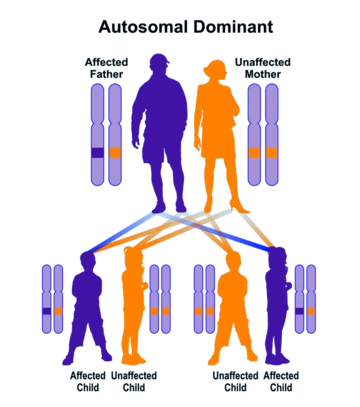
Autosomal dominant inheritance leads to a vertical pattern of transmission
Autosomal recessive
In order for autosomal recessive disorders to be expressed, offspring generally must inherit two mutations, one from each carrier parent. Carriers with only one mutation, such as the parents, do not have clinical disease. Note that carrier parents can expect that 1 in 4 children (25%) will inherit both mutations and have the disorder, 2 in 4 children (50%) will be carriers like their parents, while 1 in 4 children (25%) inherit neither mutation.

In order for autosomal recessive disorders to be expressed, offspring generally must inherit two mutations, one from each carrier parent. Carriers with only one mutation, such as the parents, do not have clinical disease. Note that carrier parents can expect that 1 in 4 children (25%) will inherit both mutations and have the disorder, 2 in 4 children (50%) will be carriers like their parents, while 1 in 4 children (25%) inherit neither mutation.